One Prompt to Playable: Shipping a 3D Game World in a Day for About $5.50
Klooboo’s runner had two worlds: a toy-bright supermarket and a lava canyon. Both took real effort to build — days of generating, converting, optimizing, and hand-tuning. For world number three, the goal was different: make the pipeline the product. If the process is repeatable enough, a new world stops being a project and becomes a prompt.
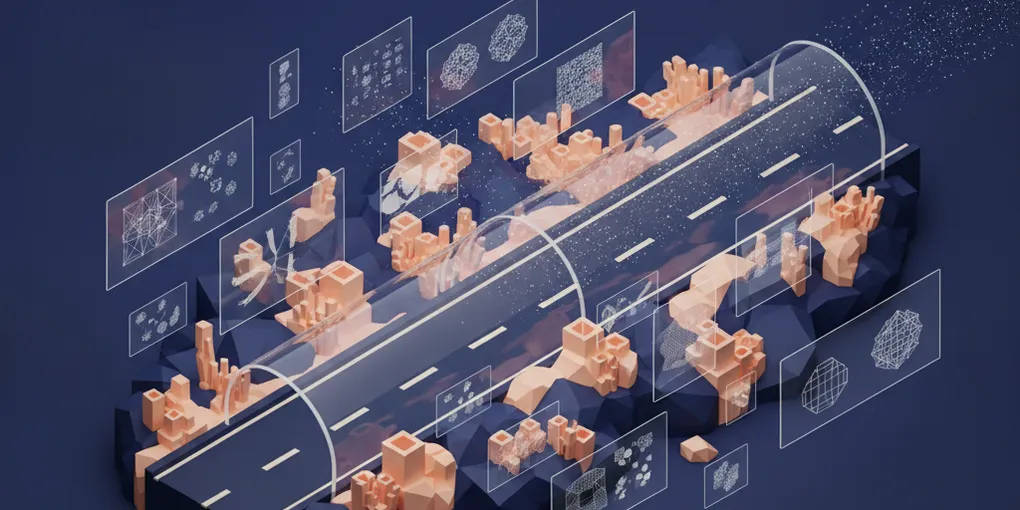
By the end of one working day, world three existed: an underwater run through a glass aquarium tunnel — glowing coral arches to slide under, giant clams to jump, a bubble-helmet diver hero, and a swirling current that comes for you when you stumble. Total generation spend: about $5.50.
Here’s how the pipeline works, and — more interesting — the three places it didn’t.
The pipeline: eight steps, two human gates
The process that emerged (and is now written down as a checklist every future world must pass):
- Concept round. Generate 3–4 gameplay-framed concept images from one prompt — same camera, same three-lane road framing, different fantasies. A human picks one. That pick becomes the style anchor for everything downstream.
- Asset image pass. From the anchor: a sky panorama (with one landmark placed at the forward bearing, so the horizon has a destination), seamlessly tiling road and floor textures, and source images for every 3D prop — single object, white background, no shadow. The generating agent self-rejects and retries before a human ever sees them; on this run 4 of 7 images got regenerated for seam kinks and composition drift nobody had to point out.
- Approval gate #1. Every image destined for 3D conversion gets human eyes before the money step. Images cost pennies; each 3D conversion costs real money. Cheap gate, placed exactly where the spend happens.
- 3D pass. Image-to-mesh conversion, raw outputs backed up, then optimized: 1024px WebP textures, mesh decimation for props. Our raw jump obstacle came out at 502k triangles; it ships at 100k and 2.5MB.
- Characters. The hero goes through rig-and-animate — run, jump, idle, dive clips bound automatically.
- Wiring. The world plugs into the engine as a registry entry: sky, textures, obstacle templates, scenery bands, fog color sampled from the sky’s own lower band so the atmosphere always matches.
- Proof. A bot that plays with real key events (never a physics-bypassing autopilot — that lie has burned us before) must finish the level cleanly.
- Ship. Models move to the CDN, sizes verified. Optimization is part of shipping, not backlog — we learned that one the hard way on Android.
The checklist matters more than the automation. A world isn’t “done” when it looks good in a screenshot; it’s done when it has both obstacle verbs (jump and duck), a themed hero, a threat, a death beat in the world’s own voice, and a bot-verified clean run. Complete by construction, not by memory.
Where human taste overruled the machine
The signature element almost got lost. The picked concept showed the run inside a glass tunnel — that was why it won. The first build shipped the coral and the road but not the glass. It took a human looking at the build to say: the tunnel is the world. Procedural glass arcs plus a fresnel canopy (nearly invisible overhead, shimmering at glancing angles) went in — zero generation cost, pure geometry and material work. The lesson: the pipeline reproduces assets reliably; it doesn’t yet know which asset is the soul.
The chaser got fired. We generated a wonderfully grumpy moray eel to chase the player. Its portrait was great. In-game, seen from behind at chase distance, it read as a beige blob — and its coiled body defeated the auto-rigger four different ways. We regenerated it in chase poses; the renders were fine and still weren’t right. So the eel is gone, and the design is better for it: the world itself became the threat. Stumble once and a current starts swirling under you; twice and the water darkens; three times and you’re swept away in a bubble burst. It’s the same mechanism our lava world uses (the ground melts under you until it’s too hot) — generalized into a rule: the environment escalates, per world, on one shared driver. New worlds now need zero character generation for their threat.
The rig fought back, twice. Two engine gotchas from the character work, recorded for posterity: a skinned mesh’s bounding box lies (measure via the skeleton, or your hero renders at double size — ours did, for a week, and we finally know why), and a low-swimming chaser can be geometrically invisible in a chase camera’s thin near-floor frustum while being perfectly positioned and textured. Both fixes are now shared code with debug hooks.
The receipts
| Phase | Cost |
|---|---|
| 4 concept images | ~$0.45 |
| 7 asset images (+4 self-rejected retries) | ~$1.20 |
| 4 props → 3D | $1.60 |
| Hero rig + animate (and the eel attempts we retired) | ~$2.30 |
| Glass tunnel, water threat, wiring, death beat | $0 (procedural) |
| Total | ~$5.50 |
One person, one day, one prompt at the start — with a fleet of coding agents doing the conversions, the wiring, and the bot-verification in parallel, and a human doing exactly two things: picking, and vetoing.
Why this is the actual feature
The world pipeline isn’t just a content tool. Klooboo’s whole premise is that kids will eventually create and remix their own worlds. Every gap the pipeline hits — a rig type that fails on serpentine bodies, a sky that needs its landmark forward, a threat that must escalate legibly — becomes a rule in the checklist, and that checklist is the future validator for kid-created worlds. We’re not hand-building content; we’re debugging the machine that will let seven-year-olds build it.
World four is one prompt away. We haven’t picked the fantasy yet — but we know exactly what “done” means.